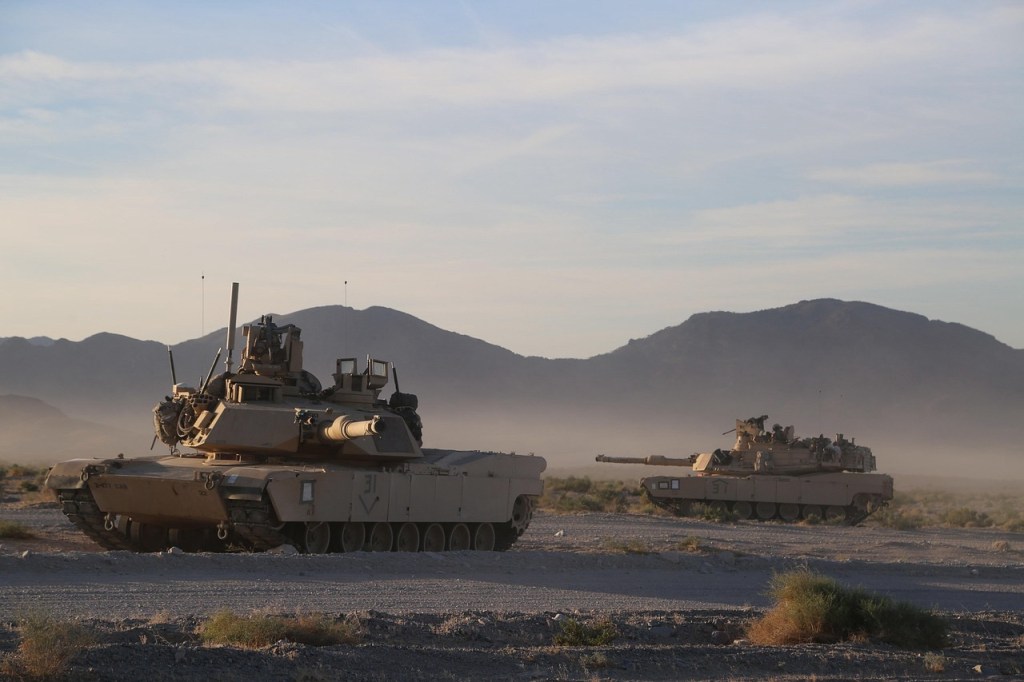
The M1 Abrams main battle tank has been the cornerstone of the U.S. Army’s armored forces since its introduction in 1980. Renowned for its advanced military technology, survivability, and lethal firepower, the Abrams has evolved through decades of innovation to remain a dominant force in modern armored warfare. This article explores the tank’s history, design, combat performance, and future upgrades, offering a comprehensive look at why it remains a global benchmark in military defense systems.
History and Development of the M1 Abrams
The M1 Abrams was developed to replace the aging M60 Patton, addressing Cold War-era threats posed by Soviet tanks like the T-72. Named after General Creighton Abrams, this main battle tank entered service in 1980, featuring revolutionary Chobham composite armor and a Honeywell AGT1500 gas turbine engine. Over 10,000 units have been produced, with continuous upgrades ensuring its relevance. Key variants include:
- M1A1 (1985): Introduced a 120mm smoothbore gun and depleted uranium armor layers.
- M1A2 SEP (System Enhancement Package): Enhanced digital systems, thermal imaging, and network-centric warfare capabilities.
- M1A2 SEPv3 (2017): Upgraded cybersecurity, an auxiliary power unit, and improved armored vehicle specifications.
Design and Technological Innovations
1. Unmatched Armor Protection
The Abrams’ advanced composite armor combines steel, ceramics, and depleted uranium, offering unparalleled defense against kinetic penetrators and shaped charges. The M1A2 SEPv3 variant incorporates Reactive Armor Tiles and modular designs, enabling rapid upgrades against emerging threats like anti-tank guided missiles (ATGMs).
2. Revolutionary Gas Turbine Engine
The AGT1500 engine delivers 1,500 horsepower, propelling the 68-ton tank to speeds of 45 mph (72 km/h). Unlike diesel engines, the turbine provides superior power-to-weight ratios but requires meticulous logistics due to higher fuel consumption. Recent prototypes, like the AbramsX, explore hybrid engines for improved efficiency.
3. Firepower and Targeting Systems
Equipped with a Rheinmetall 120mm L/44 smoothbore gun, the Abrams fires advanced munitions, including APFSDS (Armor-Piercing Fin-Stabilized Discarding Sabot) and HEAT (High-Explosive Anti-Tank) rounds. Its fire control system integrates thermal imaging, laser rangefinders, and ballistic computers, enabling first-round hits at 3,000 meters.
4. Mobility and Terrain Adaptability
A hydropneumatic suspension system allows the Abrams to navigate rough terrain at 30 mph off-road. Its range of 265 miles (426 km) underscores the importance of military logistics networks for refueling.
Combat Performance and Global Impact
The Abrams’ combat debut during the 1991 Gulf War solidified its reputation. It destroyed Iraqi T-72s with minimal losses, thanks to superior targeting systems and armor. In Iraq (2003–2011), upgraded variants countered urban threats with Trophy Active Protection Systems (APS).
Global Operators:
- Australia, Egypt, and Poland have acquired M1A2 SEPv3 tanks, reflecting NATO allies’ trust in its battle-tested design.
- Over 3,000 Abrams remain in U.S. service, with plans to modernize 1,500 to SEPv4 standards by 2025.
Challenges and Future Upgrades
1. Weight and Logistics
Weighing 68–73 tons, the Abrams requires heavy equipment transporters and airlift support, posing challenges in rapid deployment.
2. Fuel Consumption
The gas turbine’s 2–3 gallons-per-mile thirst strains supply lines, prompting research into hybrid-electric engines and alternative fuels.
3. Next-Gen Innovations: AbramsX and SEPv4
The AbramsX prototype showcases AI-driven targeting, reduced crew requirements, and a hybrid engine, aligning with the U.S. Army’s Future Vertical Lift strategy. The SEPv4 variant will feature enhanced sensors, laser warning systems, and integrated drone countermeasures.
Conclusion: The Abrams’ Enduring Legacy
The M1 Abrams tank exemplifies military innovation, adapting to evolving battlefields through cutting-edge technology. While critics highlight logistical hurdles, its unmatched survivability and firepower ensure its role in 21st-century armored warfare. As peer adversaries like Russia’s T-14 Armata emerge, the Abrams’ continuous evolution reaffirms its status as a global defense benchmark.
 The Defense Front: Understanding the World of Defense
Leave a comment