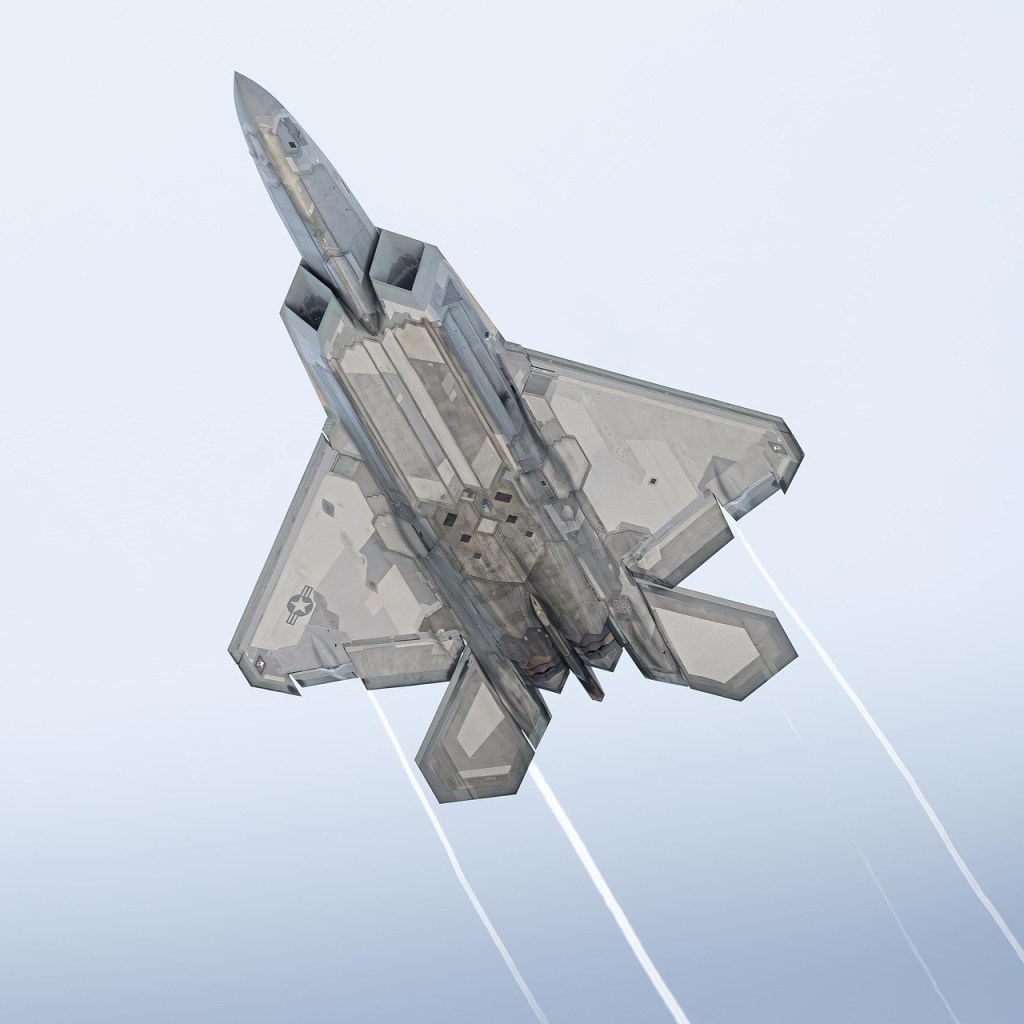
The Lockheed Martin F-22 Raptor stands as the pinnacle of air superiority fighter technology, dominating the skies since its introduction in 2005. Renowned for its stealth capabilities, unmatched agility, and network-centric warfare systems, the F-22 redefined modern aerial combat. This in-depth analysis explores its design, combat role, technological innovations, and challenges, while integrating high-quality SEO keywords to highlight its significance in 21st-century military aviation.
History and Development: Birth of a 5th-Generation Legend
The F-22 emerged from the U.S. Air Force’s Advanced Tactical Fighter (ATF) program in the 1980s, designed to counter Soviet Su-27 and MiG-29 threats. Lockheed Martin, in partnership with Boeing, won the contract in 1991, blending stealth technology, supercruise capability, and sensor fusion. Key milestones include:
- First Flight (1997): Demonstrated unprecedented maneuverability with thrust-vectoring Pratt & Whitney F119 engines.
- Operational Deployment (2005): Became the world’s first 5th-generation fighter jet, though production ended in 2011 due to high costs (only 195 built).
- Legacy: Despite its limited fleet, the F-22 remains unmatched in air dominance missions, with no combat losses recorded.
Design and Technological Innovations
1. Stealth: Invisible to Radars
The F-22’s low-observable (LO) design minimizes radar cross-section (RCS) through:
- Angled Surfaces and Radar-Absorbent Materials (RAM): Disrupts radar waves.
- Internal Weapons Bays: Eliminates external pylons that increase radar visibility.
- S-shaped Engine Intakes: Shields compressor blades from radar detection.
2. Avionics and Sensor Fusion
The Raptor’s AN/APG-77 Active Electronically Scanned Array (AESA) radar provides 360° situational awareness, detecting targets 125+ miles away. Integrated systems include:
- ALR-94 Electronic Warfare Suite: Identifies and jams enemy radars.
- Infra-Red Search and Track (IRST): Detects heat signatures without radar emissions.
- Sensor Fusion: Combines data from radar, EW, and off-board sources into a single tactical display.
3. Weapons and Payload
The F-22 carries 8 internal air-to-air missiles, including:
- AIM-120 AMRAAM (Beyond Visual Range).
- AIM-9 Sidewinder (Short-Range).
- Potential for Air-to-Ground: Modified variants can deploy 1,000-pound JDAMs in contested environments.
4. Performance: Speed, Altitude, and Agility
- Supercruise: Sustains Mach 1.5+ without afterburners, conserving fuel and reducing heat signatures.
- Top Speed: Mach 2.25 (1,500+ mph).
- Thrust-Vectoring: Executes extreme maneuvers like the “Pugachev’s Cobra”, outclassing 4th-gen fighters.
Combat Role and Strategic Impact
1. Air Superiority
The F-22’s primary role is to establish air dominance, neutralizing enemy fighters and SAM systems before they detect it. During exercises like Red Flag, it achieved kill ratios exceeding 30:1 against F-15s and F-16s.
2. Multi-Role Potential
Though optimized for air-to-air combat, upgrades enable:
- Suppression of Enemy Air Defenses (SEAD): Targeting radar installations.
- Intelligence, Surveillance, and Reconnaissance (ISR): Using advanced sensors to map battlefields.
3. Deterrence and Global Influence
- Pacific Theater: Deployed to Guam and Japan to counter China’s J-20 stealth fighter and Russian Su-57.
- Middle East: Conducted strikes against ISIS, showcasing precision in high-threat environments.
Challenges and Limitations
1. Cost and Production Halt
At $350 million per unit (including R&D), the F-22’s expense led to early production termination. The U.S. prioritized the cheaper F-35 Lightning II for mass deployment.
2. Maintenance and Readiness
- Stealth Coating: Requires meticulous upkeep in climate-controlled hangars.
- Fleet Size: Only ~180 F-22s are combat-ready, limiting large-scale operations.
3. Export Restrictions
The U.S. Congress banned F-22 exports under the Obey Amendment (1997), fearing technology leaks. This contrasts with the globally sold F-35.
Future Upgrades and Modernization
To counter emerging threats like China’s J-20 and hypersonic missiles, the USAF is investing in:
- Next-Generation Adaptive Propulsion (NGAP): New engines to enhance range and reduce infrared signatures.
- Infra-Red Countermeasures (IRCM): Defending against heat-seeking missiles.
- Advanced Sensor Fusion: Integrating AI-driven target recognition and loyal wingman drones.
- Weapons Bay Expansion: Accommodating hypersonic missiles or additional AMRAAMs.
Conclusion: The F-22’s Unrivaled Legacy
The F-22 Raptor remains the gold standard for air superiority fighters, combining stealth, speed, and lethality in a package no adversary has yet matched. While challenges like cost and fleet size persist, ongoing modernization ensures its relevance against 6th-generation threats. As peer competitors advance, the F-22’s blend of stealth fighter technology and combat-proven performance cements its role as a cornerstone of U.S. airpower.
 The Defense Front: Understanding the World of Defense
Leave a comment